AI Tools for SEO: What Still Works and What Google Ignores
Keyword research, briefs, on-page checks, technical audits, internal links and reporting: where AI tools save an SEO time, where they mislead, and what Google's own documentation says it ignores.
 Roman Shalabanov
Published
11 min read
AI tools help most with the parts of SEO that are slow but mechanical: clustering thousands of keywords, turning search results into a brief, checking hundreds of pages, suggesting internal links and summarizing reports. They help least, and can hurt you, when they publish pages for you at scale. Google's documentation is clear on both points, and it also lists several popular "AI SEO" tactics that it simply ignores.
This guide goes through an SEO's work task by task. For each one you get what AI adds, tools in our directory that do it, and the limits to watch. Google quotes come from Search Central pages read on November 19, 2026, and tool features from each vendor's own pages on the same day.
Know what Google says about AI-written pages
For Google, how content is made matters less than whether it helps people. Its page on using generative AI content says generative AI "can be particularly useful when researching a topic, and to add structure to original content". Then it draws the line. Using generative AI "to generate many pages without adding value for users may violate Google's spam policy on scaled content abuse."
The spam policies define scaled content abuse as "when many pages are generated for the primary purpose of manipulating search rankings and not helping users", "no matter how it's created". The examples include stitching together content from other pages without adding value and scraping feeds through "automated transformations like synonymizing, translating, or other obfuscation techniques".
Three more points from Search Central shape how you use AI:
- Review is mandatory. Generative models "don't retrieve facts", Google writes, so "it is critical to manually factcheck and review all AI-generated content for accuracy and trustworthiness before publishing."
- Effort counts. Google's page on helpful, people-first content says that using generative AI "to produce large amounts of text without manual oversight or curation represents little to no effort".
- Authors must be real. Google calls "fabricating creator profiles (such as by using AI-generated headshots, made-up names, or false credentials...)" a form of deception.
Match each SEO task to a tool
SEO tasks, what AI adds, and the limit to watch
| Task | What AI adds | Tools | Limit |
|---|---|---|---|
| Keyword research | Ideas, grouping, intent labels | Semrush, Ahrefs, Mangools, AnswerThePublic, SpyFu | Volumes are estimates |
| Briefs and drafts | Outlines from top results, term lists, drafts | Surfer, Clearscope, Frase, NeuronWriter, MarketMuse | Content scores are vendor metrics, not Google's |
| On-page | Titles, meta descriptions, schema | Rank Math | Meta keywords do nothing in Google |
| Technical audits | Crawling at scale, change alerts, semantic checks | Screaming Frog, Seobility, ContentKing | AI does not fix rendering or server issues |
| Internal links | Link suggestions by topic | Link Whisper, Screaming Frog | Suggestions need a human pick |
| Reporting | Dashboards, AI visibility tracking | Search Console, Otterly, Semrush, Ahrefs | AI answer tracking samples prompts |
Research keywords and topics faster
Keyword research is where AI saves the most clicking. Tools now cluster thousands of keywords into topics, label search intent and suggest questions people ask, work that used to take a spreadsheet and an afternoon.
- Semrush says it helps you "find the most relevant keywords, prompts, and topics your customers search for", and now tracks prompts in AI assistants as well as Google keywords.
- Ahrefs pairs its keyword data with an AI Content Helper and AI visibility tracking.
- Mangools offers keyword ideas with search volumes and rank tracking with weekly updates, daily on its Agency plan.
- AnswerThePublic shows the "real questions people are asking" around a seed keyword.
- SpyFu shows the SEO and PPC keywords your competitors rank for and buy.
Limits. Search volumes in every tool are modeled estimates, and AI intent labels are guesses based on wording. Check a sample of each cluster against the live results page before you build content for it. Google's guide to optimizing for generative AI features also warns against creating separate pages for every variation of a query, including the "fan-out" queries its AI features generate, when the aim is to manipulate rankings.
Turn research into briefs and drafts you edit
Content tools read the top-ranking pages for a query and turn them into a brief: headings, questions, terms to cover and a target length. Most now draft text too.
- Surfer plans and writes articles, gives each draft a Content Score and now tracks AI visibility too.
- Clearscope starts "a draft from the query's intent", grades it before it ships and, once Search Console is connected, flags pages whose grade and clicks slip.
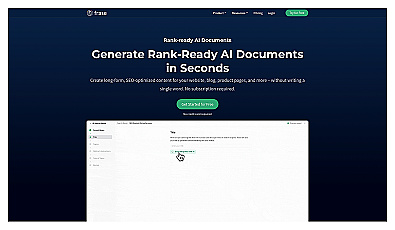
- Frase covers research, topic clusters, content optimization and a site audit, and lets you "write it yourself, together, or let Frase draft it".
- NeuronWriter analyses competitors for your target keyword, creates drafts and scores your text.
- MarketMuse, now part of Siteimprove, turns briefs into drafts.
Limits. A content grade or score measures how closely your page matches the vendor's model of the top results. Google does not use it. Google also says there is no preferred word count: its helpful content page asks "Are you writing to a particular word count because you've heard or read that Google has a preferred word count? (No, we don't.)" Use the brief to find gaps, and add what only you know: tests, numbers, screenshots, opinions. That is the "non-commodity content" Google's generative AI guide asks for.
Check on-page basics and structured data
AI is good at first drafts of title tags and meta descriptions, at spotting pages with missing or duplicate tags, and at writing JSON-LD.
- Rank Math puts its Content AI inside WordPress, with 40+ AI tools and 125+ prompts, including outlines and meta tags.
- For product pages, write schema by hand or generate it with our Schema Markup Generator, then test it in Google's Rich Results Test. Our guide to SoftwareApplication schema lists the fields Google requires.
Limits. Two old habits do nothing. Google's list of special tags says the meta keywords tag "is not used by Google Search, and it has no effect on indexing and ranking at all." And structured data, Google's generative AI guide says, "isn't required for generative AI search", though it remains worth adding because it makes you eligible for rich results.
Run technical audits and catch regressions
Crawlers find broken links, redirect chains, missing canonicals and slow pages. AI adds two things: grouping issues into readable summaries, and semantic checks that compare what pages are about.
- Screaming Frog can call AI providers during a crawl. Its user guide explains how to generate embeddings with OpenAI, Gemini or Ollama to find semantically similar pages and low-relevance content, and how custom JavaScript snippets can send page content to models such as ChatGPT.
- Seobility crawls your whole site for a technical audit and also tracks rankings, including AI Overviews.
- ContentKing, now Conductor Monitoring, watches a site around the clock and alerts you "the moment something changes".
Limits. An AI summary of an audit is only as good as the crawl under it. If your pages need JavaScript to render, check that the crawler renders them. Never let a tool auto-apply fixes on a live site without review.
Build internal links without guesswork
Internal links tell Google and readers which pages matter and how topics connect. AI tools find candidates you would miss across hundreds of posts.
- Link Whisper is a WordPress plugin that shows a panel of internal link suggestions in the post editor.
- Screaming Frog's semantic similarity report shows which pages cover close topics, which is where links help most, and where pages may compete with each other.
Limits. Suggested anchors are often clumsy or repetitive. Accept a link only when a reader would click it at that point in the text.
Report on rankings and AI visibility
Reporting now has two halves: classic rankings and clicks, and visibility in AI answers.
Start with Google Search Console. Google's generative AI guide recommends its "Generative AI performance report to see how your content is performing in generative AI features on Google Search". It is free and comes from Google's own data. For other assistants, use a third-party tracker. These tools send sets of prompts to ChatGPT, Perplexity, Gemini and others, then record whether you are mentioned or cited:
- Otterly tracks brand mentions and citations across AI engines and shows how AI agents crawl your site.
- Semrush, Ahrefs, Clearscope and NeuronWriter all now advertise AI visibility tracking next to their SEO data.
Limits. AI answers vary by user, location and wording, so trackers sample. Treat their numbers as trends across many prompts, not as a ranking. Our guide on getting recommended by ChatGPT, Perplexity and AI Overviews covers what you can influence. If you are deciding which AI crawlers to let in, read should you block GPTBot first, because blocking AI search bots removes you from their answers.

AI-driven content optimization for better engagement and visibility.
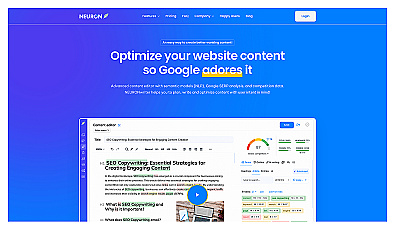
Advanced content optimization for improved search visibility.
Skip what Google ignores
Google's guide to optimizing for generative AI features, last updated July 10, 2026, has a section called "Mythbusting generative AI search: what you don't need to do". It says that, from Google Search's point of view, optimizing for generative AI search "is optimizing for the search experience, and thus still SEO". Here is what it and other Search Central pages say you can drop:
- llms.txt and other AI files. "You don't need to create new machine readable files, AI text files, markup, or Markdown to appear in Google Search", because "Google Search itself doesn't use them". Creating an llms.txt file "will neither harm nor help your site's visibility or rankings in Google Search, as Google Search ignores them."
- Chunking. "There's no requirement to break your content into tiny pieces for AI to better understand it," and "There's no ideal page length."
- Rewriting for AI. "You don't need to write in a specific way just for generative AI search," and you do not need every long-tail variation of a keyword.
- Inauthentic mentions. Seeking them "isn't as helpful as it might seem," because Google's systems focus on quality and block spam.
- Fake freshness. The helpful content page asks whether you are "changing the date of pages to make them seem fresh when the content has not substantially changed".
- Meta keywords. No effect on indexing or ranking, as quoted above.
That does not make llms.txt useless. Google says it is "completely fine" to maintain one "for other services or systems that use these files". If you want one for other AI tools, our guide on how to write an llms.txt file has examples, and the generator below builds and checks the file.
llms.txt Generator & Validator Build an llms.txt file from a form or check the structure of an existing one.FAQ
Does Google penalize AI-generated content?
Google's guidance does not ban it: its page on generative AI content says AI can help with research and structure. What its spam policies target is many pages made "without adding value for users", which they call scaled content abuse, whatever tool made them. Google also asks you to fact-check AI content before you publish it.
Which AI SEO tool should I start with?
Start with the task that takes you the most time. For research, use a keyword suite such as Semrush, Ahrefs or Mangools. For content, use a brief tool such as Surfer, Clearscope or Frase. For a technical site, a crawler such as Screaming Frog comes first. Use the free plans or trials to compare them on your own pages.
Does Google use llms.txt?
No. Google's guide to generative AI features says Google Search ignores llms.txt and similar files, and that creating one neither helps nor harms your Google rankings. Other AI services may read it.
Do content scores from SEO tools affect rankings?
No. A content score compares your page with the vendor's model of the top results. It can show gaps, but Google does not read it, and Google says it has no preferred word count.
How do I track whether AI assistants mention my site?
For Google's AI features, use the Generative AI performance report in Search Console. For ChatGPT, Perplexity and other assistants, use a tracker such as Otterly or the AI visibility reports in Semrush or Ahrefs, and read the numbers as trends, since every tracker samples prompts.