ElevenLabs Alternatives for Voiceovers and Text-to-Speech, Including Free and Local Options
Cheaper APIs, studios for video voiceovers and open-weight models that run on your own machine, compared by what the free tier allows, when you may use the audio commercially and how each one handles voice cloning consent.
 Roman Shalabanov
Published
10 min read
The best ElevenLabs alternative depends on why you are leaving. If the free plan is too small or lacks a commercial licence, Cartesia, Typecast and TTSMaker give you commercial use for less money or none. If you build an app, Inworld, Murf's API and Google Cloud bill per character and can cost far less at volume. If your scripts must never leave your computer, an open-weight model such as Kokoro or Chatterbox runs locally for free.
This guide compares those options by what the vendors publish: free allowance, commercial terms, voice cloning and the cheapest paid plan, checked on November 5, 2026 (TTSMaker on October 23, 2026). We did not rate voice quality. Voices are personal and quality varies by language, so the last section shows you how to test them on your own script in fifteen minutes.
What ElevenLabs gives you free, and where it stops
ElevenLabs' pricing page lists a free plan with 10,000 credits a month, which it estimates at about 10 minutes of text-to-speech in its app. All products, from speech to music and transcription, draw from that one pool.
Three limits push people to look elsewhere:
- No commercial licence on Free. The commercial licence and Instant Voice Cloning start on Starter, at $6 a month.
- Professional Voice Cloning starts on Creator, at $22 a month ($11 for the first month).
- Credits scale fast. Pro costs $99 for 600,000 credits and Scale $299 for 1.8 million. Annual billing gives two months free.
ElevenLabs remains the tool most others are compared with, so test it next to anything below. For every product in the category, see our ElevenLabs alternatives list or the Audio category.
ElevenLabs alternatives compared
Text-to-speech tools, checked November 5, 2026
| Tool | Best for | Free tier | Commercial use on free | Voice cloning | Paid from |
|---|---|---|---|---|---|
| ElevenLabs | Voice library, dubbing, cloning | 10,000 credits a month | No | Instant from $6, Professional from $22 | $6/month |
| Cartesia | Voice agents and API | 20,000 credits a month | No | Instant from Pro, Professional from Startup | $5/month |
| Fish Audio | Voice cloning on credits | 8,000 credits a month, 500 characters per generation | No | 3 public voice slots; enhanced cloning from Plus | $15/month (US) |
| Typecast | Character voices for video | Free voice generation, attribution required | No | Instant from first paid plan | About $5/month |
| TTSMaker (checked October 23, 2026) | Free browser voiceovers | 20,000 characters a week | ✓ (vendor says so) | No | Lite, $13.99/month |
| Inworld | Per-character API pricing | Pay as you go | Yes | 2 professional clones on pay as you go | $25 per 1M characters |
| Murf API | Cheap API speech | $10 of free API credit | Not stated | Professional cloning on Enterprise | $0.01 per 1,000 characters |
| Google Cloud TTS | Developers with steady volume | 1M characters a month (Chirp 3 HD) | Cloud terms | Instant custom voice, paid | $30 per 1M characters after quota |
"Credits" do not mean the same thing across vendors, so compare minutes of finished audio, not credit counts.
Best for video voiceovers and narration
If you make videos, courses or explainers, you want a studio where you paste a script, pick a voice, fix pronunciation and download audio.
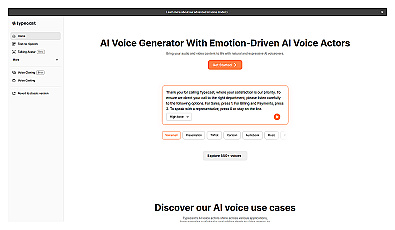
Typecast focuses on character voices with emotions. Its pricing page says "Voice generation and playback are free on every plan" and credits are used only when you download. On the free plan you can download trial voices, and "Attribution is required for all content downloaded on the Free plan." The first paid plan adds instant cloning, watermark-free video exports and a commercial licence.
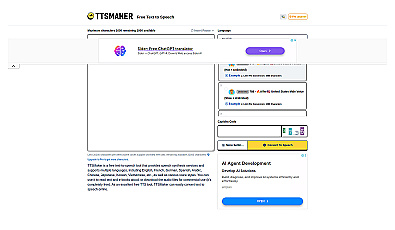
TTSMaker runs in the browser. As of October 23, 2026, the site allowed 20,000 characters a week, with some voices marked unlimited, and said you have "100% commercial usage rights for generated audio". The voices are plainer than ElevenLabs', but for a tutorial or a product demo that may be enough.
Murf started as a voiceover studio. Its pricing page now leads with the API: a free trial with $10 of API credit, then $0.01 per 1,000 characters for its Falcon 2.1 model and $0.03 for the more expressive Gen2 voices. Studio and dubbing plans sit on separate tabs of the same page.
Best for developers and voice agents
If you call a text-to-speech API from your own product, latency, price per character and licence matter more than the editor.
- Cartesia sells text-to-speech, speech-to-text and voice agents. Its pricing gives 20,000 free credits a month; Pro at $5 a month adds the commercial licence and instant cloning, and Startup at $49 adds professional cloning.
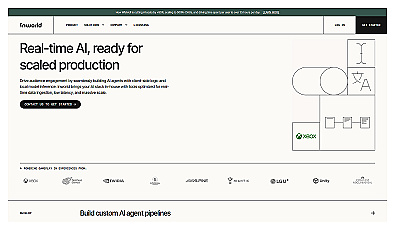
- Inworld sells speech by the character. On its pay-as-you-go plan, the pricing page lists $25 per million characters for TTS-2 and $15 for TTS-2 Flash, with voice cloning and a commercial licence included.
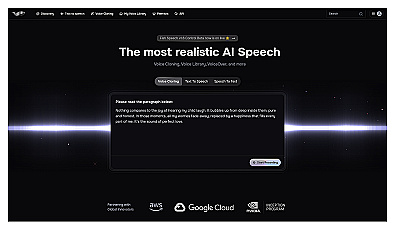
- Fish Audio sells speech and voice cloning by credits, with public and private voice slots. The free tier gives 8,000 credits a month, up to about 7 minutes, with 500 characters per generation; commercial use and enhanced cloning start on Plus.
- Google Cloud Text-to-Speech includes 1 million characters a month free for Chirp 3 HD voices and 4 million for Standard and WaveNet voices. After that, Chirp 3 HD costs $30 per million characters (Google Cloud pricing). You must enable billing even to use the free quota.
To estimate an API bill, count characters, not words. A 1,500-word script is roughly 9,000 characters with spaces, so at $25 per million characters it costs about 23 cents to generate once. That is a worked example, not a quote; retries and longer scripts add up.
Open-weight models you can run offline
An open-weight model runs on your own computer. Your script never reaches a vendor, there is no monthly cap, and the only cost is hardware and setup time. You will need some comfort with Python or a community app that wraps the model.
The licence decides whether you may use the audio commercially. These are the licences on each model's official page, checked November 5, 2026:
Open-weight text-to-speech models
| Model | Licence | Voice cloning | Commercial use |
|---|---|---|---|
| Kokoro (82M) | Apache 2.0 | ✗ (preset voices) | Yes |
| Chatterbox (Turbo, Nano, Multilingual) | MIT | Yes | Yes |
| Dia (1.6B, English only) | Apache 2.0 | ✓ (5 to 10 s sample) | Yes |
| Piper | GPL-3.0 engine, licence per voice | No | Check each voice |
| XTTS-v2 | Coqui Public Model License | Yes | No |
| F5-TTS | CC BY-NC 4.0 | Yes | No |
| Fish Speech 1.5 | CC BY-NC-SA 4.0 | Yes | No |
A few notes from the model pages:
- Kokoro is the light option. Its README describes 82 million parameters with "Apache-licensed weights" and says it is "significantly faster and more cost-efficient" than larger models at comparable quality.
- Chatterbox comes from Resemble AI, which says that as of August 2026 it is retired research and no longer maintained; the code stays public under the MIT licence. The repository offers a 350M Turbo model with tags such as
[laugh], a 110M Nano model that it says runs "3x faster than realtime on 8 CPU cores", and a 500M multilingual model for 23+ languages. Every file it generates carries Resemble's imperceptible Perth watermark, which a script in the repository can detect. - Dia, from Nari Labs, generates dialogue between speakers tagged
[S1]and[S2]and can copy a voice from a 5 to 10 second sample. It "only supports English generation at the moment" (README). - Piper describes itself as a "fast and local neural text-to-speech engine". It is now developed as piper1-gpl under GPL-3.0. Each voice has its own model card and licence.
- XTTS-v2, F5-TTS and Fish Speech 1.5 are widely shared, but their weights are licensed for non-commercial use only (XTTS-v2, F5-TTS, Fish Speech). Use them to experiment, not for a paid voiceover.
Voice cloning: the consent rules that apply
Cloning is where voice tools get people into trouble, so the larger vendors build checks into the product.
- ElevenLabs says: "You can only create a Professional Voice Clone of your own voice", and "Even with their consent, you cannot clone someone else's voice" that way. Every Professional Voice Clone goes through a verification step to confirm the voice is yours (ElevenLabs docs). If someone else wants to share their voice with you, they create and verify the clone themselves.
- US robocalls. In February 2024 the FCC ruled that AI-generated voices, including voice clones, are "artificial" voices under the Telephone Consumer Protection Act. Calls that use them need the called party's prior express consent unless an exemption applies (FCC).
- Platforms. YouTube requires creators to disclose realistic AI content, such as making a real person appear to say something they did not. Its help page lists "cloning one's own voice to create voice overs or dubs" as something you do not need to disclose (YouTube Help). Our guide to AI tools for YouTubers covers the rest of those rules.
Laws on voice and likeness differ by country and, in the US, by state. This is a summary of vendor rules and one federal ruling, not legal advice. For anything beyond your own voice, get the person's written permission that names the project, the languages and how long you may use the clone, and keep the original recording.
How to choose in fifteen minutes
- Write a 150-word test script with your hardest parts: a brand name, a number, an acronym and a question.
- Run it through three tools from different groups in the first table: one studio, one API and one open model if you can install it.
- Listen on headphones and on a phone speaker. Note mispronunciations, unnatural pauses and how each voice reads the question.
- Check the export: file format, sample rate and whether the free download carries a watermark or needs attribution.
- Re-read the commercial-use column for the winner before you publish anything that earns money.
If none of these fit, our AI Tool Finder pulls audio tools from the directory by budget and audience, with free plans first if you ask for them.
AI Tool Finder Answer three questions and get matching tools from our directory.FAQ
Is there a free ElevenLabs alternative for commercial use?
Yes, with limits. As of October 23, 2026, TTSMaker said its free audio came with commercial usage rights, up to 20,000 characters a week. Kokoro and Chatterbox are open-weight models under Apache 2.0 and MIT that you can run for free. ElevenLabs' own free plan does not include a commercial licence.
What is the cheapest ElevenLabs alternative with a commercial licence?
Among hosted services we checked, Cartesia Pro at $5 a month and Typecast's first paid plan at about $5 a month were the lowest, as of November 5, 2026. For an API, Inworld charges $15 to $25 per million characters with a commercial licence included.
Can I run text-to-speech offline?
Yes. Kokoro, Chatterbox, Dia and Piper run locally after you download the model, so your text is not uploaded. Check each model's licence: XTTS-v2, F5-TTS and Fish Speech 1.5 are non-commercial.
Can I clone someone else's voice with their permission?
On ElevenLabs, not as a Professional Voice Clone: the person must create and verify it and share it with you. Other services set their own consent checks, so read their terms. Whatever the tool, get written permission and follow the laws where you publish.
Do I have to disclose an AI voiceover on YouTube?
Not if you clone your own voice for a voiceover or dub, according to YouTube's help page. You must disclose realistic content that makes a real person appear to say something they did not say.